Submission strategy checklist: reduce cycles before you upload
Reading time ~10 minutes · Updated August 5, 2025
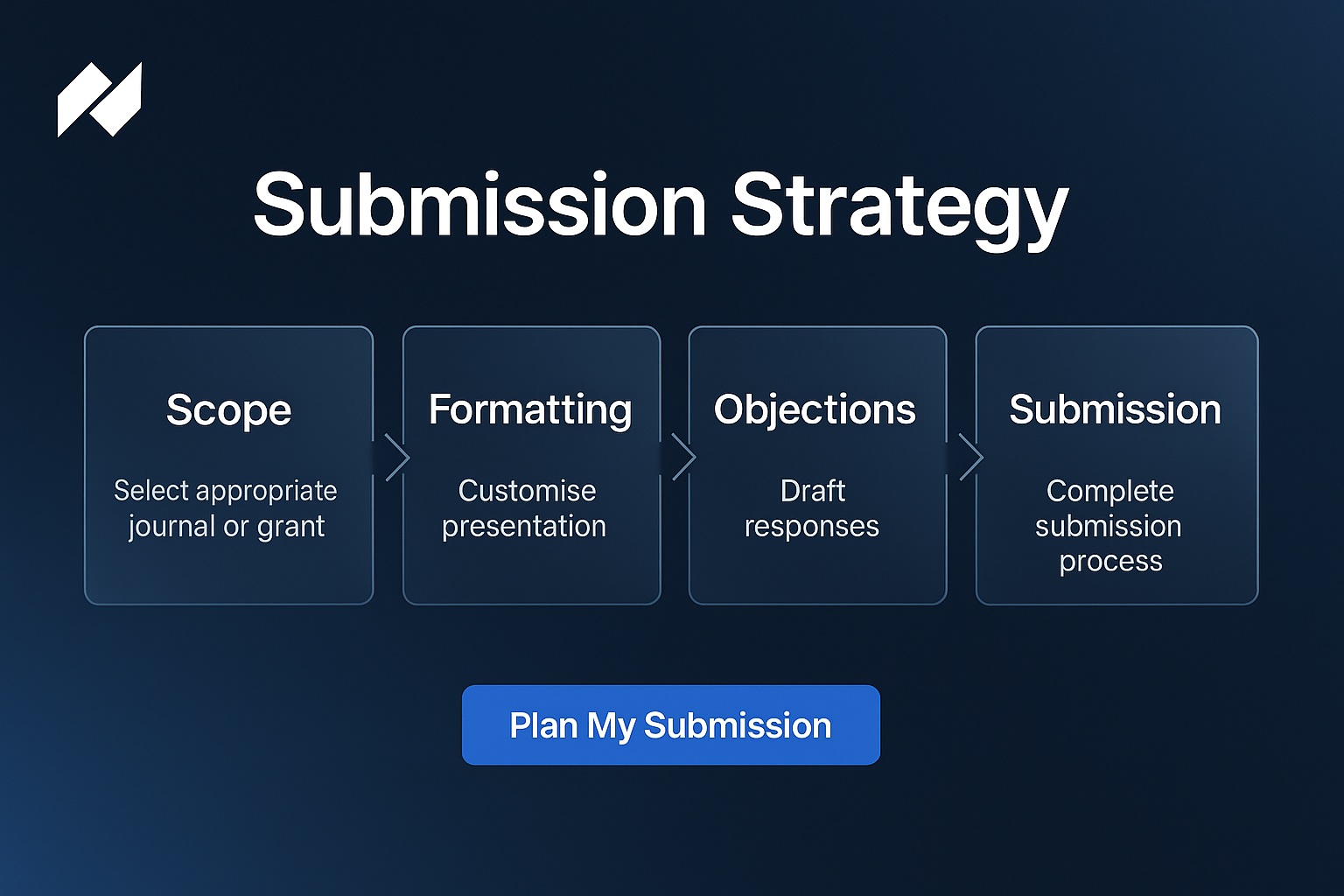
1) Select a journal that matches your contribution
Editors filter by fit first. Map your work to the audience and scope of a shortlist rather than aiming at prestige alone.
Signals you have a good fit
- Recent articles address the same problem class and methods.
- Your primary result matches the journal’s typical effect size or novelty bar.
- Citation network overlaps with your references.
- Word, figure, and data policies match your manuscript’s shape.
Signals of a poor fit
- Most recent articles target a different community or organism/system.
- The journal disfavors your study type (e.g., incremental method tweaks).
- Formatting or length limits force heavy cuts of key results.
How to shortlist (30 minutes): choose three journals: one stretch, one realistic, one safety. For each, copy a recent accepted article similar to yours and mirror its structure at a high level.
2) Align conventions on day one
Conventions are low-effort but high-impact because they remove editorial friction. Set these before any polishing pass.
Convention checklist
- Target’s reference style and in-text format applied consistently.
- Figure limits, resolution, color profile, and caption length met.
- Abstract word limit respected; keywords use the journal’s taxonomy.
- Naming, symbols, and units harmonized; abbreviations defined at first use.
- Data and code availability statements written, with DOIs where possible.
- Ethics approvals and consent statements present where required.
3) Pre-empt reviewer objections
Most reviews raise predictable questions. Add margin notes or an appendix that addresses them before submission.
Common objections to neutralize
- Scope/novelty: Clarify what changes versus prior work and why it matters to the field.
- Methods detail: List parameters, versions, and controls so the study is reproducible.
- Statistics: Report n, effect size, and CI/SD/SE as appropriate; justify tests used.
- Interpretation: Separate observation from speculation; state limits first.
- Generality: Bound claims to the data and conditions you actually tested.
4) Build a submission package editors like
Editors see three things quickly
- Title: specific and informative, not hype.
- Abstract: claim → evidence → delta vs. prior work.
- Figures: one idea per figure, captions stand alone.
Attach a clean, polite cover letter that explains fit and discloses conflicts/overlap. Ensure files upload without errors and that metadata matches the manuscript (author order, affiliations, keywords).
A one-week submission timeline
- Day 1: Shortlist three journals; pick one. Mirror their structure.
- Day 2: Apply conventions (references, limits, figures, statements).
- Day 3: Pre-empt objections; add methods detail and limits.
- Day 4: Clarity pass (claims, transitions, sentence load).
- Day 5: Final figure and caption audit; internal read-through.
- Day 6: Cover letter, disclosures, metadata; upload once.
- Day 7: Rest. If needed, send a polite presubmission inquiry to the next journal on the list.
Mini templates
Cover letter outline (fill the brackets)
Dear Editor,
We submit “[Title]” to [Journal]. The paper shows [main claim] supported by [core evidence]. Compared with [closest prior work], we provide [delta/advance], which is relevant to [journal audience].
The manuscript complies with [policies/limits]. Data and code are available at [DOI/link]. There are no conflicts of interest [or disclose here].
We believe the work fits the journal scope because [one-sentence fit statement].
Sincerely,
[Names and affiliations]
Response-letter structure (for later)
- Group by reviewer and numbered comment.
- For each comment: Claim → Evidence → Change.
- Quote the change with line numbers; keep tone neutral.
Common traps
- Submitting to an aspirational journal with a mismatched audience.
- Cutting figures or methods to fit an arbitrary word limit.
- Uploading with inconsistent metadata (author order, affiliations).
- Relying on a literal translation without localization for reviewer expectations.
- Waiting to plan the response letter until after the decision.
Tags: Journal submission Peer review Scientific writing